Bipolar disorder
The Book of MirrorsBipolar disorder is named in the account of Frank Spoel’s commitment to Trenton Psychiatric Hospital: Joseph Wieder assesses Spoel as having the disorder and recommends that he be sent to a mental hospital. The diagnosis has an immediate legal consequence, while the broader investigation shows how psychiatric labels can also diminish a witness’s credibility without establishing that the witness has this particular condition.
Diagnosis and Legal Context
In the fall of 1985, Spoel was arrested after beating a man and taking money from his pockets. The confrontation followed a dispute over counterfeit French perfume that Spoel had received in exchange for cigarettes. Facing the possibility of trial as an adult and a sentence of five to eight years, he was advised by his public defender, Terry Duanne, to pursue a finding of temporary insanity instead.
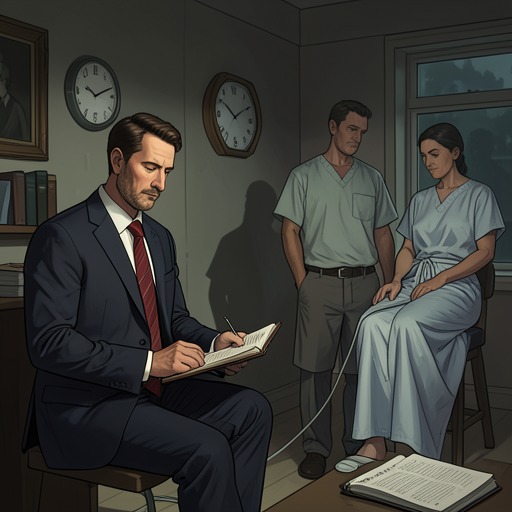
Wieder examined Spoel, concluded that he was suffering from bipolar disorder, and recommended commitment. A few days later, Spoel was taken to Trenton Psychiatric Hospital. He expected to be discharged within a couple of months and regarded hospitalization as preferable to Bayside Prison. The evidence establishes the diagnosis and recommendation, but does not explain the clinical basis for Wieder’s conclusion or describe the symptoms on which he relied.
Commitment and Its Uncertain Outcome
Spoel’s expectation of a short stay does not settle what happened next. When asked why he was not discharged, he responds by asking whether the questioner has ever been in a psychiatric hospital. The exchange sets Spoel’s earlier confidence against the fact that his hospitalization continued beyond what he anticipated, but the available account does not specify the full duration of his commitment or provide his answer about its circumstances.
The diagnosis therefore functions most clearly as part of a legal and institutional decision: it directs Spoel away from an adult criminal trial and into psychiatric care. The account offers no basis for treating the diagnosis as a complete explanation of Spoel’s conduct or subsequent experience.
Illness, Testimony, and Credibility
A separate strand of the investigation concerns Derek Simmons, whose testimony about Joseph Wieder’s murder is weakened in the eyes of police because he is described as ill, amnesiac, and mentally unreliable. Simmons himself anticipates that his history of accusation, hospitalization, and medication would have led an attorney to portray his account as invention or hallucination. He insists that he knows what he saw, yet believes that his statement would not have been taken seriously.
The narrative does not identify Simmons’s condition as bipolar disorder. Keeping his case distinct from Spoel’s diagnosis matters: the investigation links psychiatric history and amnesia to the discounting of testimony, but does not make them interchangeable diagnoses. Simmons’s competing account of the murder remains contested, and his illness is presented as part of the reason his version was not treated as decisive evidence.
Narrative Significance
Bipolar disorder appears within a story in which legal outcomes and judgments about truth depend partly on who is considered credible. Spoel’s diagnosis supplies the stated grounds for psychiatric commitment; Simmons’s illness and amnesia are invoked to cast doubt on what he says he witnessed. Together, these episodes show the consequences of medical and legal classifications, while leaving the facts of Spoel’s clinical assessment—and the reliability of Simmons’s disputed testimony—only partly resolved.